
The Steps Taken to Optimize Crucial Parts of the Project & the Relevant Sections of FIRST to Follow
First published in FLEXO Magazine, October 2018 issue.
Written by Harper Technical Director, Sean Teufler
The “FIRST in Motion” project culminated in a presentation during the session of the same name at Forum 2018 in Indianapolis, IN. Previous FLEXO Magazine articles chronicling the project (published in the August 2018 and September 2018 issues) dealt with objectives, details, and a look into initial processes.
The purpose of the project, from my perspective, was to demonstrate the adaptability of a FIRST-oriented printer in the utilization of a “new-to-its process” plate technology. This is not an easy challenge for a printer that does not possess the diligence and background I will describe in this article.
The real secret to success with optimization is no secret at all when you see it in action: It is the execution of a well-written plan where everyone knows each person’s role and responsibilities.
The other purpose of this article is to outline the importance of ink and press optimization and reasoning behind them, as specified by FIRST. FIRST, of course, is an acronym for Flexographic Image Reproduction Specifications & Tolerances. It comprises a collection of industry knowledge and serves as the ultimate guideline for the flexographic workflow. It is important to distinguish the meaning of the term “guideline.” In our sense, it serves to tell us that the document provides a means to achieve the most from your capability, having created such a capability that allows you to maintain process control and achieve repeatability. A printer must create that capability, and we found this project was a clear demonstration of that from the ink and press optimization.
OPTIMIZATION & THE PRESSROOM
Let us consider the larger context before we look into the steps of optimization. The guideline I just mentioned helps build the foundation for the print dynamic. That foundation also consists of practice and repetition to maintain the print dynamic. This means when the day of the trial comes, you are able to perform all the functions of measurement, preparation, and selection.

Always look to eliminate sources of contamination, like the residues on the ink lids shown here. All photos courtesy of Sean Teufler
The only things you should learn during a fingerprint or characterization are the presses’ capabilities, not whether you can measure, clean or print consistently. If you find yourself doctoring inks, changing aniloxes or switching decks, then you have not optimized the press or its components. Worse, you may find there is an issue with its condition and preparation. Waiting until the day of the trial to practice how to use your measuring equipment, prepare chambers and aniloxes, manage viscosity and maximize printability is akin to waiting to study for an exam until the day of the test. In both scenarios, you will quickly discover that you should have been much better prepared.
What is optimization, in the terms of the pressroom? Optimization finds its initial roots in FIRST Section 1.3.1, Press Optimization. This section is a must-read, as it speaks to the fundamentals we strongly expressed in our “FIRST in Motion” presentations regarding control and measurement within the confines of normal, everyday practices. Keep in mind, these must be good practices for legitimacy, rooted in FIRST.
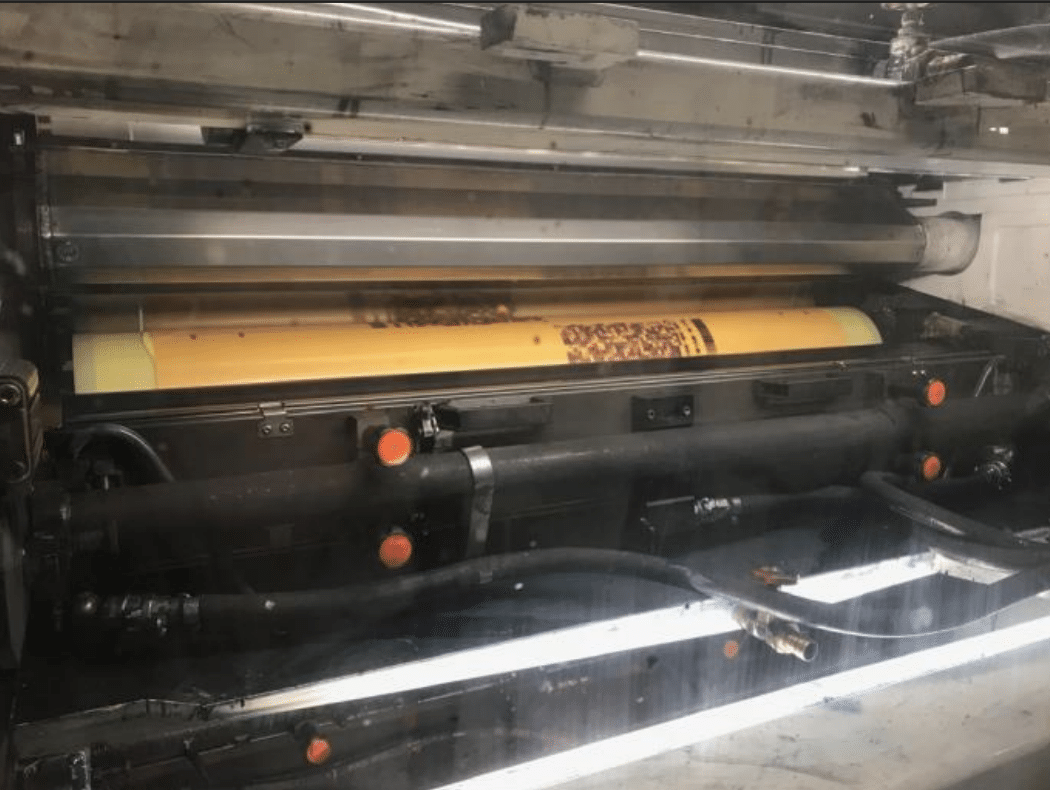
Aclean, well-balancedchamber creates the opportunity for even ink transfer
For our fingerprint and characterization trials, and the press run itself, the only variable was the substitution of a different plate technology into the existing workflow. The optimization was based on these everyday practices. This put the burden of impartial testing firmly on the shoulders of the press department. The essential parameters for the test conditions included viscosity range, ink temperature, contamination-free equipment and clean aniloxes that have been verified at the required volumes. Although it is briefly mentioned in the section as even delivery, the chamber system is another variable that must be accounted for during an optimization and day-to-day operations. It is not enough to have optimization without the organizational background, discussion and conveying of understanding. FIRST Section 1.4.2.3, Communication is where we learn that we must have press operators, inkroom personnel, and production management teams working toward the same goal and to effectively express what is going right or wrong, and why. These goals must be established and agreed upon, and preparations must take place before any trials. Those participating must understand the goals and their role in meeting each of them. The optimization question then becomes how to actively evaluate. Think of it in this context: Can we sustain a stable print condition? This evaluation is done only through the work of measurement.
ON-PRESS INK CONTROL
FIRST Section 20.2.6, On-Press Ink Control discusses the measurement of temperature and viscosity. Viscosity is temperature dependent for more than just measurement. It is also a prime indicator of the condition of the ink. What does temperature mean to a printer? It means to always be aware of operating temperatures for your inks and surrounding systems, such as pumps and dryers. Operating at temperatures in excess of the accepted range can adversely affect solvent- and water-based ink performance. Solvent inks will flash off solvent quicker and at different evaporation rates, affecting balance and dry rate through the anilox-plate-substrate transfer process. For the printer, this means a constantly changing print dynamic of dot gain, color and chance for defects. Water-based inks may lose their pH balance and begin to kick out at higher temperatures. This quickly affects color strength and clean transfer.
When it comes to your own setup, you want to become proficient in your temperature and viscosity measurements. Infrared temperature measurement is very useful as an external verification. You will also want to provide training in the proper use, care and selection of the viscosity cup. Many viscosity measurements are fooled by dirty or damaged cups. Selecting a viscosity cup would seem simple enough, but for accurate measurement you need to be using the exact same brand—not just the same number—as they may not perform the same. In other trials we have experienced measurement differences of seven seconds or more in cups that were supposed to measure exactly the same, so be sure to test them to a calibrated standard before issuing for use. We also often find damaged and dirty cups being used, and these create considerable print defects as inks are misadjusted to a false viscosity. Understanding how to use a cup, how to hold it, how to accurately gauge the break, and when to start and stop the time measurement are all important functions of a proper manual viscosity check.

It is essential to properly calibrate the inline viscosity settings with accurate cup measurements.
Once your viscosity cups and your ability to use them correctly are validated, they become a powerful tool in ink stability and provide a foundation. You can then build redundancy through the use of calibrated inline systems for viscosity and temperature measurement. These systems are ideal for monitoring and maintenance control of both temperature and viscosity. They are set through hand measurements mentioned in the prior passage. Being able to accurately and independently verify confirms your automated measurements are within expected tolerances. Sometimes indications of instability in the print are just an indication viscosity control is either not happening or not being calibrated properly.
Contamination can also affect color control, so any press components that come in contact with the wet ink must also be contamination-free. Doing otherwise risks unmitigated color shifts without another cleanup and a replacement of the ink. This would mean the sump, pump, internal piping, anilox, chamber or blade system, and any viscosity cups used must all be contamination-free.
20.4.2, ANILOX SELECTION
In terms of anilox selection, we worked with the existing inventory of high-line, low-volume aniloxes on the “FIRST in Motion” print project. The anilox specifications had been optimized for the existing process workflow. The requirements for our trial were the volumes needed to support color achievement at a printable viscosity
Once established, the maintenance of the anilox cell condition becomes paramount to any future success. You can easily fall in the trap with solvent inks where you achieve color but cannot sustain it due to an imbalance of pigment load, vehicle and solvent. Don’t let dirty cells contribute to changes when the condition can be so easily rectified with cleaning. Aniloxes always need to be cleaned and verified along with the sequence of ink and anilox placement, known as the anilox deck sequencing. This is to ensure consecutive setups follow the exact same anilox placement and condition. Why would that be important? You are wanting to minimize any potential variation and any conditions in individual stations can be spotted much more easily and traced to the source of the variation when you are not mixing and matching components.
20.4, INK METERING SYSTEM
The ink metering system is a vital macrostructure within optimization. Macrostructure refers to the machine-tolerance precision with which a metering system must operate. Changes in blade angle, sweep, and tip consistency can adversely affect ink film transfer by allowing too much ink to pass through. More importantly, the inconsistency as the blade re-seats—changes angle to compensate for excess pressure—adds to a constantly changing print dynamic that runs entirely counter to the whole purpose of optimization. The condition of components, including any doctoring assemblies and especially chambers, is critical. An ideal and attainable setup would have the following features:
• Low pressure on the blades
• No leaking around the seals and blade areas
• A kiss impression
• Chambers and pumps free of contamination
When we speak of FIRST, we must begin with press optimization. Everything defined afterward—the fingerprint, characterization and every subsequent press run—relies on the achievement and sustainment of the press optimization. I have been to many trials where there was more discovery than actionable use of the presstime. I am happy to say that Plastic PackagingTechnologiesLLC—where the “FIRSTin Motion” print run took place—was not one of those places.
I always remain a skeptic when analyzing because when you stop being skeptical, you start making assumptions that make you overlook key points. The first thing you should check is how well the trial parameters are communicated. I met with the staff and discovered all the aniloxes were clean, ordered and mounted in the racking, where they were identified and organized. All the inks were properly set to viscosity and maintained throughout the trial. The racking of decks was done with precision and care. The chambers were built properly and were free of contamination—precisely the type of setup you would expect from a sustained optimization—and the delivery was spot on.
Everything came together right on time and the only small delay was laying out the measurement plan for the trial itself. You could not have asked for more from the press crew, ink team or pressroom management that day. The real secret to success with optimization is no secret at all when you see it in action: It is the execution of a well-written plan where everyone knows each person’s role and responsibilities.
When dealing with FIRST, you must embrace what the words tell you and make them come alive in your pressroom. FIRST comes to fruition in many specific flexographic processes but none are as universally important as optimization. What does FIRST tell us? It tells us to communicate among teams and to pay attention to individual steps taken. It then tells us to evaluate steps by measurement and finally and most importantly, to keep the process within stable, acceptable parameters.

A look at the entire web—CMYK on the left, expanded gamut (EG) on the right—from the project at the center of “FIRST in Motion.” Concept and design by Bob Coomes of Plastic Packaging Technologies LLC, and Patrick King & Charlie O’Shields of VENN49 Creative Lab. Prepress and color management by Mike Jeroutek & Kerry Thonen of The ALC Group
 About the Author: Sean Teufler is a Technical Director for Harper Corporation of America and holds FIRST Implementation Specialist Certification.
Sean has been in the industry since 1991 when he started out as an ink technician. He has held technical and sales positions with Harpersince 2003. He is a seven time tech of the year award winner for Harper. Sean co-chaired FTA’s Fall Conference 2012 and 2016. He became chair of FTA’s Supplier Leadership Council in 2017 and has spoken at numerous Fall Conferences and Forum events, participated in the judging for FTA’s Excellence in Flexography Awards Competition, and led two Flexo Quality Consortium (FQC) projects, one of which garnered him a President’sAward for Leadership Excellence in 2012.
To view the original FLEXO Magazine article click HERE.



Leave a Reply
Want to join the discussion?Feel free to contribute!