Improved production efficiency and profitability are just two byproducts of a well thought out maintenance program for anilox rolls.

First published in Package Impressions Magazine, September 2013 issue.

Written by Harper Technical Graphics Advisor, Sean Teufler


If you are looking to improve flexographic production efficiency, there is no greater place than aniloxes to focus your energies. We know aniloxes play a critical role to the printing process and any anilox problems can cause great disruption to expected outcomes. What we will sometimes encounter in the field is a lack of quality anilox care, which leads to wasted substrate, time, and labor. These are concerns near and dear to every alert owner and production manager.

There are a number of reasons that create these problems, but they always come down to just a few things. Sometimes the problem is having the correct tools and sometimes it is a matter of understanding how to use those tools correctly. These are easy problems to fix. Problems can arise on a broader scope as well, so we will look into the anilox workflow and how to develop a true pattern of efficiency.

Getting started, we begin to understand by learning how the three major anilox systems of storage, protection, and handling contribute to anilox care. We will then need a comprehensive review of the anilox workflow to assess deficiencies in the process, whether it is equipment, personnel, and/or method. We finish by developing routines through a process of documentation, training, and using the right products for the job.


Storage, protection, handling

Anilox efficiency begins not at the press, but with anilox storage because of damage potential. Storage concepts vary from using the original container from the anilox supplier to mobile or static storage systems. The keys for any storage system follows.

We recommend physically storing the anilox in a manner that protects the engraving, and there are many elements to that end. First, you would include a design that keeps the anilox to the interior of the proposed storage, not exposing the engravings externally to passing hazards. Often it is a great idea to conceal anilox journals within the confines of the rack to keep anything from striking the journal and dislodging the anilox from the rack. Internalization of the anilox within the storage device also applies to stowing sleeve aniloxes.

For obvious reasons, it is important that the storage system itself does not contribute to anilox damage, especially when placing or removing the anilox from the storage unit. For metal racks, this means any metal surfaces that could come in contact with the anilox face must be shielded with rubber or foam. Upright supports and the frame are usually eligible to provide this unwanted contact, so look there first. There are a number of ways available to pad the storage unit. For racks with pegs, you can slip slightly longer ink tubing over the pegs and then you have a simple barrier to prevent contact with the engraved face of the anilox. Make sure the pegs are to the inside of the frame, or the anilox will surely rest on the frame itself. Sleeve racks should have rubber or plastic bump-stops that prevent the sleeve from striking a support or weld at the back of the unit. Sleeve racks can get too crowded for the available space, especially if loading sleeves that have a larger diameter than intended for the rack. You do not want any anilox sleeves coming in contact with another anilox sleeve. Short slide-out extensions can be made to ensure the sleeve cannot drop on the sleeve below without clearance. If your journalled aniloxes require hoists to remove and install at the storage system, locate the system so it is centered to help prevent the possibility of contact from the pendulum movement of the heavy anilox.

Transportation devices should be dedicated to aniloxes and not used for other press material. Sometimes we see anilox carts that also have flexible dies, plate cylinders, and other equipment sharing a very tight space on a cart and the aniloxes stored with these items are not well-shielded from contact. Keep in mind that storage should maintain protection, not expose the anilox surface to greater risk. If a cart or carts cannot be dedicated to aniloxes, then consider isolating aniloxes as much as possible from the other parts by using roll covers and fixed shielding.

We definitely recommend you consider specialty carts for anilox sleeves. Mobile sleeve carts provide a safe storage area and a transition/access point for the sleeves being removed or installed at press. This is a feature that cannot be understated. The other option, a concrete floor, is dangerous for the sleeve for two reasons. Sleeves are difficult to place on a bare concrete floor without damaging and floors do not provide any lateral stability, making sleeves easy to tip over. It is not recommended to never stand an anilox or anilox sleeve on the floor, but to transfer directly to and from the cart or storage rack. If you have no other choice, at least consider using sturdy rubber mats to guard the anilox from the hard concrete surface.

When it comes to anilox protection, the racks are not the only things you need. You should also consider roll or sleeve covers. These devices provide the first-line of defense and their use has saved many an engraving from gouges, drag marks, and chips. They also serve well as dust covers and to prevent contamination of the engraving surface by oil or grease. Most anilox covers have traditionally been leather and come padded or unpadded with or without edge protection, depending on your preference. Hard plastic covers have become popular, either choosing split for journal aniloxes or unsplit for slipping over anilox sleeves. Once any roll cover becomes soiled, we recommend you clean them so the engraving surface does not get contaminated with grease, oil, or ink residue.


Anilox workflow

We have already discussed the methods for storing and protection, now you must consider the broader subject of workflow. The anilox workflow also starts at storage. Sometimes the storage racks themselves are mobile and can be positioned in a manner that allows easy access at press. If that is not available, it is recommended to have a cart that allows the aniloxes to be transported without hand-carrying them. The cart must maintain the same secure conditions as the storage does, or it becomes a likely location where damage can occur. The workflow then moves on to the press itself. If gears and bearings are installed at this point, a workstation should be in place that is free of any debris and a secure method for keeping the anilox in place by use of static, locked-down v-blocks. It is suggested to maintain any roll cover protection during transportation and installation of the anilox. When the roll or sleeve is secure in press, only then should the cover be removed.


Anilox cleaning

Once the anilox has finished its task in press, then it is time to move on to proper cleaning. Thorough anilox cleanups in press are sometimes errantly skipped to save time; as we have learned, however, a plugged anilox will cost you production and eliminate any time savings. The reality is that by using the right cleaning products and procedures, it takes very little time to clean an anilox. The cleaning process is not just scrubbing, but also rinsing, drying, and installing the protective cover. The slight investment in time is compensated by not having to transfer an inked anilox that will drip, or in the case of an anilox slated for reuse on the next job, the needed volume is maintained and helps avoid all of the related costs of additional cleaning, adjusting inks, and wasting substrate. The catch here is getting the right products involved instead of compromising.

While there are many revolutionary products in the printing industry for cleaning aniloxes away from the press, the trend for in-press solutions has rebounded to a degree, mainly because printers have found cleaners and equipment that are much more efficient and effective than in the past. For a primary system like anilox cleaning in press, it has been a matter of developing tools that clean without damaging the anilox surface. Gone are the abrasive pads and cleaners. They have been replaced with sponges, foam cleaning pads, and non-corrosive inkemulsifying cleaners.

Mobile sleeve carts provide a safe storage area and a transition/access point for the sleeves being removed or installed at press.

Cleaning at press has a twofold benefit. First, you save on the time it takes to remove the anilox, which on older presses is an important consideration, and you greatly diminish the opportunity to damage the anilox as it is transported. Secondary systems are categorized as external cleaning methods, typically equipment-based but can also include an area where aniloxes are manually cleaned away from press. These secondary systems are often an effective time-saving solution when used properly. The key to effectiveness is having the system tuned to OEM specifications and making sure the system is periodically maintained. When cleaning effectiveness wanes and/or anilox damage occurs, you will often find the settings are no longer correct because the system has not been maintained sufficiently and instead of a simple part replacement, the problem has been bypassed instead of addressed. Poor cleaning, anilox damage, and extensive cleaning cycles are the result, wasting time and money.


These secondary systems may also require bearing and gear removal or protection devices to prevent damage to those components, adding preparation time. Look to minimize the time it takes to protect the bearings by using rubber gloves that are secured over the bearings/journals and consider more robust guards like shielding or caps that can seal them off from the cleaning liquid or media. The guards are simple to install and take a few seconds of time and the problem is resolved without spending time to prepare the aniloxes. You will often find the suppliers of those systems also supply guards that are custom-fitted to the bearing/gear design of your particular aniloxes.


A winning routine

It must be mentioned that while many of these ideas are inherently obvious to most, every detail may not be apparent to everyone you employ and thus the need to have procedures written down that describe exactly how you want the aniloxes to be cared for and what will be your expectations of the condition. It is unrealistic to expect everyone given the task of cleaning aniloxes to fully understand the process without some training, guidance, and a demonstrated competence.

Keep in mind that storage should maintain protection, not expose the anilox surface to greater risk.

Any of the procedures, from cleaning to transportation to storage, can be broken down and recorded into a documentable method so that anyone asked to perform those tasks can do so to a level that yields the most efficient outcome for their anilox condition. Sufficient training and an explanation of why things are done a certain way lends to getting a credible effort by those tasked with cleaning and caring for the aniloxes. We recommend getting your team together to form one document for each task. There may be some variation due to press configurations but the core tenets will stay the same.

In the following example, the general method for an anilox cleanup of a narrow-web press using a single-blade unit and subsequent storage away from press:

• Documentation example—Back off blade pressure, allowing ink to build on anilox surface to keep it wet. Stop the anilox. Drain the ink from the tray. Immediately address the wet ink on the anilox surface by using a spray cleaner, keeping the anilox wet until the anilox surface can be cleaned and rinsed. Dry the cleaned anilox and prepare to protect it with a roll cover before removal. Carefully remove the covered anilox from the press and transport it to the storage area by use of a protective anilox cart.

You should also consider procedures for secondary cleaning systems, press installation and removal, gear and bearing installation and removal, inspection, troubleshooting, and so on.

Inefficiency is an unwanted byproduct that occurs when one or more of anilox protection, care, and maintenance duties fall short of reasonable expectations. Those who measure their productivity and waste can capture the signs of inefficiency and begin to do something about it. You will see the savings in time and money by following the recommendations for anilox protection, care, and maintenance because a damaged or dirty anilox in inventory only wastes an operator’s time. In addition, if the anilox is unique, you may have to compromise at press by selecting a roll with a different line and volume. Compromise from a designated setup always adds waste as adjustments are made.


Optimal results

When aniloxes are prepared and cared for properly, you get the exact results the prepress, operator, and ink technician would expect. Having the correct tools and the knowledge to use them allows your employees to perform their jobs efficiently. Tools and knowledge help optimize conditions, so providing the right finished product with low makeready waste and in a timely manner become a normal practice. It is recommended that you review storage, cleaning, and maintenance processes with your anilox supplier to make sure you are making all the right choices to preserve your anilox investment.

We advise every printer to reject the status quo of day-to-day operations by making frequent reviews of how processes could improve to create the desired anilox process efficiencies.


About the Author: Sean Teufler, technical graphics advisor with Harper Corp. of America, has 22 years of experience in the flexographic industry.


To view the original Package Impressions Magazine article click HERE.

Education Is Key to the Transformation

First published in FLEXO Magazine, August 2013 issue.

Written by Gerry O’Hanlon


Growing up in Glasgow, Scotland in the early 1970s and 1980s, companies all around were sponsoring apprenticeship programs for students graduating high school. It was an interesting concept to me that a company would train me for four years and pay me at the same time. An apprenticeship was not easy to get. Generally, you had to either know someone on the inside, or be very lucky to land one. I fell into both categories and landed an apprenticeship with one of the biggest printing companies in Europe. Better still, I earned myself a scholarship to the London College of Printing.

Very early on in my apprenticeship, I learned how to operate several different pieces of printing equipment. Often, I was left in charge of the machine and knew exactly which buttons to push and when to push them. Trusted to run this equipment, I still did not know exactly why I was pushing some of the buttons. It took many years of training and several organized training courses and procedures to get me where I needed to be.

Training offered me the opportunity to get a great education, as well as a chance to land a top job in Scotland—difficult in a country with almost 20 percent unemployment. At its conclusion, I had a trade and was trained by some of the best talent in Europe and in the industry. As a result, I was very fortunate to emigrate to the United States of America in 1998, to train employees at one of America’s top packaging companies. The company that brought me to the U.S. had a desire to create a great training program for its employees and give them a similar opportunity to the one I received.

Today, I take great satisfaction in helping transform some great operators into great printers, using a similar model to the one afforded to me. The industry we work in needs printers, not operators! It needs to listen to the people who perform the tasks necessary to make a quality package. The only way to turn an operator into a printer is to establish a world-class training program at your facility.


PUT PEOPLE FIRST

A wise boss once told me one day when I was complaining about getting calls at all hours of the night with our operators having printing issues. He said “Gerry, it’s all your fault.” Trying to see through the red in my eyes, I asked him “Why?” He told me the following:

1. If you receive a call from the plant and you resolve the problem on the phone, it’s a communication issue

2. If you receive a call from the plant and you come in and fix the problem, it’s a training issue

3. If you receive a call from the plant and you need maintenance assistance, it’s a preventive maintenance program issue

He was so right and his advice changed my approach and my quality of life. I set forth on assembling a logbook of all calls. From there, I set about creating a root cause analysis for each call and then implementing corrective/preventive actions for each issue. Within one year, I was receiving no calls from the plant.

What we did to rectify the situation was not perfect, but we did improve our communication, our training, and our preventive/predictive maintenance. Most importantly, we involved our most valuable asset, our people.

The employees operating our equipment every day earned the title and opportunity to do so, however, we often fail to trust them to assist in developing training programs and continuing to build on their own education in our industry.

How would you feel if you found out some of the original equipment manufacturers that we purchase millions of dollars of equipment every day from failed to invest in their employees’ education and did not grant them opportunities to train on the equipment they use and build every day?


RESOURCES & RESULTS

There are state and federal initiatives providing grant money to bring in experts who can train your staff on the trade.

One great resource available to everyone in the flexo industry is Flexographic Technical Association’s Flexographic Image Reproduction Specifications and Tolerances (FIRST). The intention of this manual is to provide all participants in the flexographic reproduction process with a common set of guidelines, tutorials and data that can be used as communication and production tools. Some of the world’s leading companies and tradesmen contributed to the development of this manual. If used, it can only help improve any printer’s process and education.

Many of your company’s vendors also offer training programs and as mentioned before, many are free. A statistic that blew my mind when joining Harper Corporation was that, 80 percent of our business comes from damaged or worn rollers, yet our company has a full technical support team of highly skilled individuals that spend hundreds of thousands of dollars each year educating and supporting our customers on care and maintenance of their anilox rolls and sleeves.

Scenes from a Harper Corporation WalkingSeminar. Photos: Harper Corporation of America.

Harper also offers a free WalkingSeminar at its manufacturing facilities in Charlotte, NC, and Green Bay, WI. They allow customers an inside-look at all aspects of anilox manufacturing. Participants have the opportunity to interact with the Graphics Center and Graphic Solutions teams and learn how to increase press speeds, reduce downtime, print consistently, cut waste, trim set-up time and control inventory.

If everyone reading this article actively improves his/her training and press maintenance programs, our industry will thrive competitively for many years to come. Everyone should agree that the most valuable asset in our industry is our people. If we do not invest in the education and training of our people, our industry will throw away countless dollars and continue to struggle unnecessarily to compete.

If you continue to improve and your competition does not, you will win. Status quo is not a survival or evolutionary tactic. The printing industry needs printers, not just operators, to survive! Invest in your operators and give them the opportunity to become great printers.


About The Author: Gerry O’Hanlon has 25+ years of experience in the printing industry and holds a City & Guilds from the London College of Printing, which equates to a Bachelor’s Degree in Printing Management and Printing Science, accredited by Clemson University. Born in Glasgow, Scotland, O’Hanlon immigrated to the United States in 1998. O’Hanlon’s expertise has been shaped by his professional history, which includes a four-year apprenticeship with John Horn-Rexam. He has designed numerous team building activities, facilitated multiple training classes, and led cost-saving Six Sigma initiatives.


To view the original Package Impressions Magazine article click HERE.
Precise Structure and Shape Meets Tight Printing Requirements

First published in FLEXO Magazine, July 2013 issue.

Written by Harper GraphicSolutions Director, Alexander James


Increasing sophistication in the label industry has created a demand for in-line and cost-effective solutions to meet the label buyer’s needs. Along with many specialty applications, the requirement of the best opacity in white, while maintaining cost-efficiency has finally been met.

Dynamic graphics and special effects can be created in today’s flexographic industry using the right anilox engraving. Due to improved laser technology and the skill in application, there are a number of channeled engravings that work well for creating the high opacity whites, interesting spot varnish effects and eye-catching special effects. Not to be forgotten, the graphic demands for process and expanded gamut have increased dramatically over the last few years.

The tried-and-true technology of consistent closed cell 60-degree engravings has continued to prove to be the choice of many printers, prepress houses and plate suppliers.

Cross section of 60-degree hexagonal anilox cell.


HIGH-END GRAPHICS

High-end, high definition-graphics, requires the precise ink delivery of closed cells and not surprisingly the XLT-60° hexagonal engraving is perfect for those requirements. Gone are the days where “fade to nothing” is not possible. Today using the latest plating and prepress technology, combined with the proper anilox engraving specification, it is entirely possible to have smooth transitions where vignettes fade to nothing.

Additionally, graphic reproduction continues to increase the resolution of the graphic images and thus increase lpi of the polymer, resulting in high-quality graphics being applied to a majority of today’s products. Four-color process printing is now the norm and expanded gamut printing – sevencolor—continues to grow. Complementing this trend, anilox requirements have moved to increased need for engravings with much higher specifications of CPI (cells per inch) – also referred to as line-screen – and bcm (billion cubic microns) – also known as volume.

These 1600cpi, 1400cpi & 1200cpi, XLT-60° aniloxs all deliver very specific ink film thickness and enable the reproduction of the most high-end graphics in a controlled and repeatable manner. The trend to the higher anilox cell counts is noticeably increasing in both the narrow web market and the wide web market. This trend mirrors the increased graphics improvements with higher plate lpi and the increased use of color and print targets.

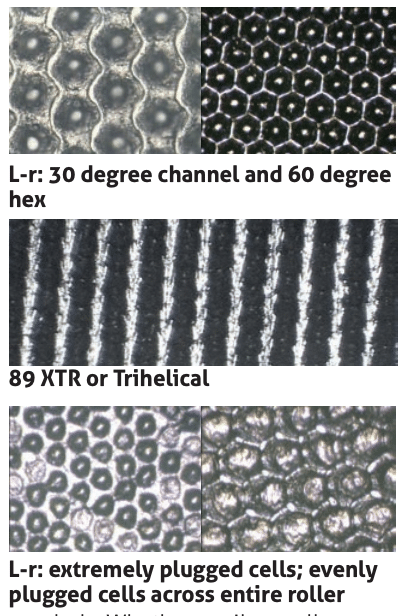
Channeled anilox roll engraving patterns. Photos/illustrations: Harper Corporation of America.

Across both narrow web and wide web markets, printers are using print targets that range in density numbers, dot gain tolerances, L*a*b*, and G7 tolerances. The complexity of the color separations and builds require precise ink delivery specifications. The XLT-60° hexagonal has precise structure and shape, for this reason it is the ideal anilox to meet today’s tight print requirements. Engraving of the hexagonal shape can be orchestrated with extreme accuracy, provided the anilox bases and ceramic are precisely and consistently prepared.


HIGH OPACITY WHITE

Traditionally, in order to achieve high opaque white in flexography, it was necessary to use a rotary screen station. While this approach is effective, it does require setup time and limits the production speed of the press. In addition, should the rotary screen get damaged at any time during production, the change out and re-setup of a replacement screen can be quite time consuming.

Fortunately, today’s anilox technologies offer a great option for achieving the same results in a fast paced productive manner. Channeled engravings such as 30°, 75°, 89°, 45° and weave can efficiently deliver heavy opacity whites for any ink system in use. Using the right anilox engraving, it is entirely possible to achieve opacity levels with solvent inks in the mid to upper 60 percentile, water-based inks in the mid 60 percentile and with UV inks, opacity in the mid to upper 80 percentile.

With XTR engravings, it is common to engrave heavy volumes that can deliver a specified amount of coating, while the anilox remains clean during long pressruns.

These channel engravings, can deliver a much greater level of ink, almost pouring the ink on to your substrate. These engravings have large openings and with the right engraving specifications, white inks can flow freely in and out of the channels. Channeled anilox rolls are available to deliver just about any level of opacity you may be looking to achieve. The only question is, “Can you dry or cure it?”

Channeled anilox engravings can be available with volumes ranging from heavy volume — 20 bcm to 40 bcm + — to low volumes of 20 bcm or lower. Having the right setup makes the biggest difference.

Using water-based inks to achieve high opaque whites may require installing high capacity dryers and possible changing the web path to extend the drying time before laying down the second color on top of the white. Channeled engravings such as 30°, 75°, 89°, 45° and weave can efficiently deliver high opacity whites for any ink system in use, especially with UV inks. Engravings have been used with UV inks that have achieved opacity of 70 percent or better.

Engage your ink supplier and anilox supplier in a discussion of your goal and define the percentage opacity you want to achieve. Using the right ink formulation and anilox specification to conduct tests, you will find the right combination that will meet your goal.


VARNISHES

Matte and gloss varnishes have been used effectively in the offset industry for years. There has been an increased interest and subsequent use of these varnishes in the flexographic industry as work has transferred to in-line processes. Using new channeling engravings — XTR 89° & 75° — has resulted in smooth laydown of both matte and gloss varnish coatings.

These new type of engravings enable the varnish to flow smoothly from the anilox rolls in the web direction. The benefit of not having cross supports in the 89° XTR engraving and the shape of the channels — large channel opening — enables any coating to flow effortlessly in and out of the channels with minimal disturbance that would result in agitation and foaming. With the XTR engravings, it is common to engrave heavy volumes that can deliver a specified amount of coating, while the anilox remains clean during long pressruns.

Using the right anilox specification and a spot plate, it is possible to create dynamic effects by combining matte and gloss effects in the same graphics. Many ink suppliers have tested the technology and have ready-made recommendations for these applications. Having the matte and gloss varnish can create increased visual depth in your graphics that allows the product to stand out. The sheen of the gloss spot varnish tends to pull that area to the eye.


METALLIC/FLUORESCENT INKS

Large channel engravings work well for these extra-large pigmented inks

Solids or combination – using metallic inks and fluorescent inks—can truly enhance your product, but have often been difficult to harness for flexo because of particle size and clumping/ agglomeration of the pigments. Those issues have been resolved with the application of channel engravings.

For solids, the anilox engraving requirements will be moderately heavy – between 5 bcm to 16 bcm, depending on testing results for strength. Channel engravings, such as the weave and the 30° channel with low engraving specification, are ideal for the heavy solids. If there is a need for combinations of solids and screens, then the 30° channel and XLT-60° works well.

It is always a good idea to communicate with your ink supplier to review recommendations for specific ink systems. Each ink vendor has different formulation for different inks.


COLD FOIL & SCENTED

Cold Foil is another way of creating exciting graphics. Selecting the proper anilox engraving to laydown the right level of adhesive for cold foil allows the application to be run in a very productive setup. The result is a cost effective, dynamic graphic.

Scented inks are another option for differentiating your graphics. We are all familiar with scratch-and-sniff products, but in today’s world they can be done more and more with the flexographic process. Choosing the anilox engravings with shallow depths and large openings will enable the scented pigments to easily flow in and out of the engravings, resulting in the desired transfer without breaking many of the encapsulations.

Sustaining the encapsulation is the key to success and can be done to great effect with today’s variety of channel engravings.


THERMO-CHROMATIC & TACTILE INKS

Color changing inks, or thermo-chromatic inks, have long been used in the beer industry, as a positive indicator for a cold beverage. This effect can also be used in other industries to create interesting effects. Applying spot thermo-chromatic inks can be used to enhance specific areas to reveal specific information or graphic elements.

Tactile inks provide a raised effect that is interesting to the touch. Once only found in screen printing, developments in the varnish and engravings have made it possible to achieve desirable effects in flexography.

Channeled anilox rolls with heavy volumes work well to create raised areas for enhancement of the end product. Along with the heavy volume anilox rolls, part of the challenge will be curing the tactile inks. Having at the minimum, 400 watt UV lamps will be required.

Additionally, it might also be necessary to adjust the web path to give the tactile coating additional time to fully cure and set-up. The addition of a mobile curing unit will help capture the raised effect on the web as quickly as possible and enhance the results. The tactile effect can be used in a variety of ways – as water droplets, stitching on a baseball, or raised effect on a logo.


GLITTER INKS

Large channel engravings work well for these extra-large pigmented inks. Channel anilox rolls with heavy volumes and large openings enable the pigments to tumble and flow into and out of the engraving and onto the substrates. One of the challenges with the large pigments is the need to keep the pigments in suspension in order to properly transfer from the anilox roll to the plate and substrate and that can be achieved with a varnish designed for the purpose.

Along with opportunities for use of these different anilox engravings with these different graphic enhancing inks, comes the need to clean the rolls as soon as each pressrun is finished to prevent lock-up of the carrying vehicle in the cells.

Be sure your current cleaning methods also apply to these specialty applications. As chemistries may not respond, contact the ink supplier for proper cleanup instructions for those formulations.

Today’s anilox technologies can truly help to enhance the various graphics, thus differentiating your product against the competition. To take advantage of the opportunity of these different ways to create dynamic graphic effects, it is necessary to do your homework.

Coordinate with your anilox supplier and ink suppliers. Schedule banded roll print trials to determine what combination of ink and anilox works effectively. Put together banded roll layouts that include a variety of different engravings targeted to address your goal.

A banded roll trial will also enable you to test other variables, such as drying or curing requirements, and press setup. During testing, you should also determine optimum press speed. We have found that testing the new plating technologies, along with different stickyback and polymer can truly make a difference.

Using the right anilox technology and coordinating with your ink and anilox suppliers, it is truly possible to create and print dynamic products.


About the Author: Alexander James is the director of Harper GraphicSolutions, the technical division of Harper Corporation of America, Charlotte, NC. Alex has a Master of Science degree in graphic communications from Clemson University and a Bachelors of Fine Arts from the University of North Carolina, Asheville. With more than 20 years of experience in the graphics industry, Alex has presented at numerous industry related events. Alex has traveled globally, nurturing and developing business relationships by assisting customers in establishing print workflows, improving efficiencies and productivity.


To view the original FLEXO Magazine article click HERE.
Anilox technology has come a long way from the days of knurled base cylinders with chrome plating or sprayed ceramic, and today there are a wide variety of engravings available for the flexographic printing and coating industries.

First published in FlexoTech Magazine, July/August 2013 issue.

Written by Harper GraphicSolutions Director, Alexander James


The choice of anilox engravings available in today’s market range from 60° hexagonal cells to different cell shapes and various channeled engravings.

The specific goals and requirements of a job will determine what type of anilox engraving and specifications will fit the needs. For process printing, achieving precision and specific print targets is the ongoing trend while combination/screen printing demands aniloxes that can deliver enough volume to achieve a predetermined solid print target and also print a smooth screen, vignette and spot colour. With whites and coatings, the goal is to achieve a specific coat weight, a specific gloss or a specific opacity percentage.


Factors

Most of today’s printers have learned the value of printing by the numbers, and as such, have characterised their presses and correlated their print targets to their variables in order to ensure a high level of productivity and repeatability.

This need for consistency requires an anilox technology that can be engraved with high precision and consistency. Aside from the new laser technologies, the most important part of ensuring consistency of the anilox engraving is the preparation of the anilox base and ceramic. Cylindrical consistency across and around the base is important for both the traditional base and the anilox sleeve base.

Another important factor is the consistent application of ceramic onto each roller to maintain tight properties of low porosity and consistent hardness. Finally, a consistent surface finish prior to engraving will ensure that once the laser has been calibrated to a specific engraving, the result will be spot on.


In the Process

Process printing is now the norm for a majority of flexographic printing applications. Technological advancements across the board now enable the proliferation of four color process printing in both the wide web and narrow web industries.

We see high definition printing and expanded gamut printing with photopolymer resolution ranging from 150 lines per inch (lpi) to 200 lpi in the narrow web market. In the wide web market, the trend to higher photopolymer lpi is the same, 150 lpi to 175 lpi. This trend requires a shift in the inks and anilox rollers to meet the graphic reproduction expectations.

In order to print to specific targets, the anilox chosen must deliver a consistent and precise level of ink film thickness. If print target tolerance is within a !E of 2 or a density target of +/- .05, it will require an anilox that can meet those requirements. For these requirements, minimising variability is key.

With six cells walls, the hexagonal cell shape has the most structural support compared to other engravings. Additionally, the nesting of the hexagonal cell results in 15% more cells per square inch with thinner walls and smaller posts. These attributes greatly contribute to the consistent delivery of the 60° hex engravings for precision colour reproduction. With the precision and consistency of these cells, flexographers can use the same anilox specification on any number of presses and be sure that they will be able to achieve the desired print target.

Fig 1. Anilox engraving options from Harper: 60° Hex, 70° Hex, KatRon (long cells), 30° Channel, Weave Channel, 89° XTR and 45° Trihelical

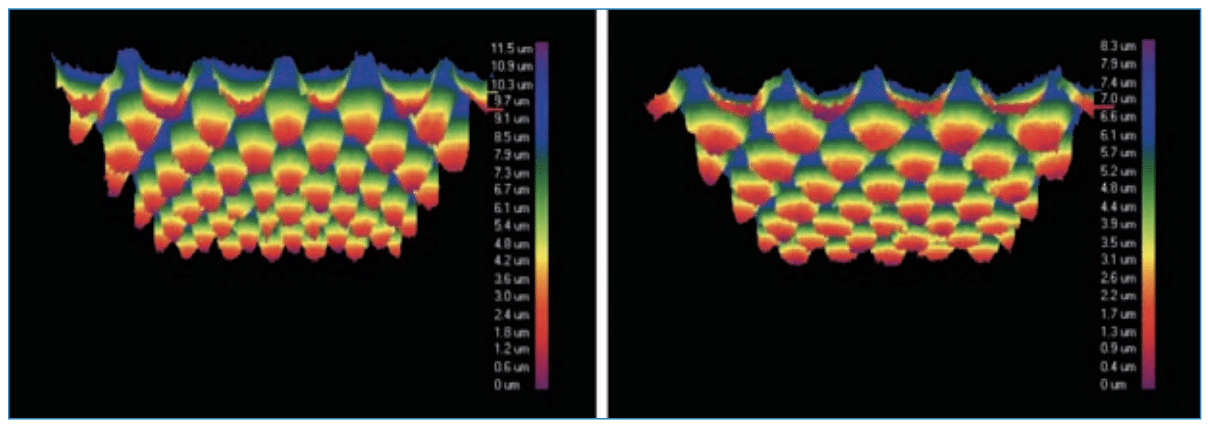
Engraving the hexagonal cells and controlling the cell opening, depth and shape is a critical part of delivering consistent ink film thickness to the photopolymer. As visible in fig 2, when engraving specifications have heavy BCM on the finer engravings, the cell shape inevitable form more of a conical shape. Cells with conical shapes will plug much quicker and function in an efficient manner compared to bowl shaped cells, regardless of the type of engraving geometry.

Fig 2. Cell shapes

This ability to consistently engrave an anilox, as an example, using 473 lpcm (lines per cm), 1200 cpi (cells per square inch), 3.10 cm3/m2, 2.0 bcm (billion cubic microns) with a cell opening of 19 microns and wall thickness of 2 microns is what enables printers to confidently establish print targets with tolerances that they can consistently achieve.

Plates with 59 lpcm/150 lpi resolution printing with a 1% dot, will have a dot diameter of 19 microns, which is equal to the cell opening of the 473 lpcm/1200 cpi engraving. For high definition, high quality printing, the relationship between the minimum dot and the cell opening should be the following – the cell opening should be equal to or smaller than the dot diameter of the smallest printable dot. Controlling that relationship will ensure the delivery of just the right amount of ink to the plate dots, which is a primary way one can control the consistency of the printed results. The relationship of cell opening to minimum printable dot applies to any level of flexo printing, but especially to high definition printing, four colour process printing and expanded gamut printing. Adhering to the cell opening and dot diameter relationship will result in quality printing regardless if you are printing with water-based, UV or solventbased inks.

Other engravings, such as Harper’s 70° Hex (larger cell shape) or the KatRon (stretched hexagonal cell shape), work well for printing combinations of solids and screens and are dictated by the pigment shape and certain ink rheologies.

These engravings are also applicable on uncoated, porous substrates. The challenge is controlling the right amount of ink to ensure a consistent amount will be delivered to the dots. Don’t be surprised of excessive dot gain, dot bridging – dirty print – when using these cell shapes with 1% dots at 150+ lpi due to the increase in open surface area per anilox cells.

When choosing large anilox cell shapes that deliver more ink, it is helpful to take the time to conduct banded roller trials to ascertain the adjustments that may be needed to the inks, plates or tape. For example at 175 lpi, you may need to switch from a 1% dot, which has a diameter of 16 microns, to a 3% dot, which has a diameter of 28 microns, in order to minimise potential printability issues and ensure efficient productivity results. Larger or stretched cell shapes by their structure will deliver a greater percentage of ink and work well for solids and screens with large minimum dots and on uncoated, porous substrates.


Open engravings

Open cell anilox engravings have different structures, primarily channel openings and parallel cell walls. These parallel walls can be engraved at different angles or with different curvilinear shapes. The nature of these shapes allows for excellent flow of inks through the channels, which is great for solids and screens with large dots and specialty inks such as fluorescent, metallic, glitter and specialty varnishes and adhesives.

The ease of ink flow into and out of the open cell engraving lends their use to thicker inks and coatings. When applying specialty coatings and inks, there are several things to consider; the most important variable is the particle or pigment size of the coating or ink. The anilox must have the cell opening which will enable the pigments or particles to easily flow into and out of the engravings. This is especially important for specialty large particle metallic or glitter inks.

Open cell engravings, such as the XTR–89°, have been very beneficial for water-based adhesives and coatings that have issues such as foaming. Especially with enclosed chamber coating stations, the engraved channels allows the coatings to flow easily and levitates the pressure that can build up inside the chamber which contributes to excessive foaming.

Another area where the open cell engravings are beneficial is with whites, specifically heavy UV whites. By using the right open cell engraving it is possible to have anilox engravings with 18 bcm to 24 bcm and more that can compete with rotary screen applied whites. When testing for the right combination of anilox engraving to use with whites or any other coatings, a numerical target must be established. For example, if you are testing for improved white opacity, it is necessary to know what the current opacity percentage is and what the target for improved opacity may be. The same goes for gloss varnish or coat weight improvements.

Fig 3. Fade to zero – 200 lpi dot

A great approach is to conduct banded roller trial that has the current anilox cell structure and the various available open cell anilox engravings on the same roller. This enables a comparison of the benefits for different anilox engravings in a side by side setup. Always use a quantifiable measurable approach when comparing against the standard and refer back to the numerical anilox specification.


Daily Protocol

Today with the increased trend to aniloxes with much finer engraving specifications, the printed image continues to reach higher photographic quality levels. Today’s anilox manufacturers are consistently engraving aniloxes for process printing in ranges from 315 lpcm/800cpi, to as high as 630 lpcm/1600 cpi. And in specialty application engravings have been manufacturing as high as 788 lpcm/2000 cpi.

An anilox with higher engravings has cells with smaller openings and can only perform consistently if the cells are kept clean. This will require adjustments in daily protocol, including more frequent cleaning. Regardless of the geometry selection, when choosing engravings with deep volumes, the cell shapes are more conical and will be a challenge to efficiently maintain. These aniloxes must be cleaned more frequently compared to the traditional aniloxes with lower cell specifications. The need for care and maintenance protocol adjustment continues to be one of the greatest challenges customers have when choosing to work with higher cell count and deeper engravings. By adopting proper cleaning protocols, printers can take advantage of the variety of engravings currently available.


About the Author: Alexander James is the director of Harper GraphicSolutions, the technical division of Harper Corporation of America, Charlotte, NC. Alex has a Master of Science degree in graphic communications from Clemson University and a Bachelors of Fine Arts from the University of North Carolina, Asheville. With more than 20 years of experience in the graphics industry, Alex has presented at numerous industry related events. Alex has traveled globally, nurturing and developing business relationships by assisting customers in establishing print workflows, improving efficiencies and productivity.


To view the original FlexoTech Magazine article click HERE.

Pressroom Awareness Makes Both Possible

First published in FLEXO Magazine, June 2013 issue.

Written by Harper Technical Solutions Manager, Bill Poulson


An anilox roller is a precision tool that is used in the flexographic printing process. Handling techniques will have a lot to do with how it performs, as well as how it will last through its lifecycle. Many variables within the flexo process can cause premature wear or damage to the anilox roller. All are areas that affect the efficiency and finally the profitability of the manufacturing process and anilox roller budget. Many of these issues also have a direct effect on run time efficiencies of the pressroom.

When production is stopped for unexpected anilox roller changes or unnecessary downtime, the plant is losing money. Two areas worth focusing on in attempting to alleviate the problems are anilox management and the doctoring of ink through the flexo process.

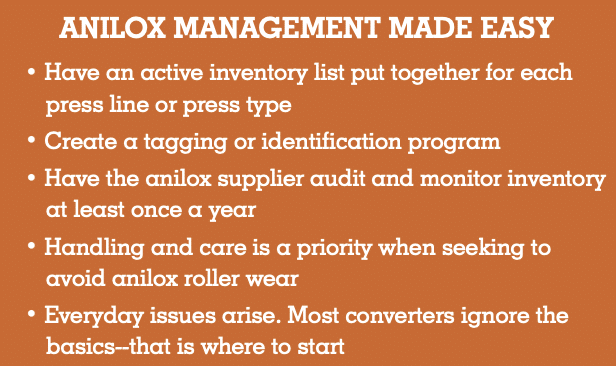
It’s a given that every flexo printing plant should have an anilox management program. Essential elements follow:

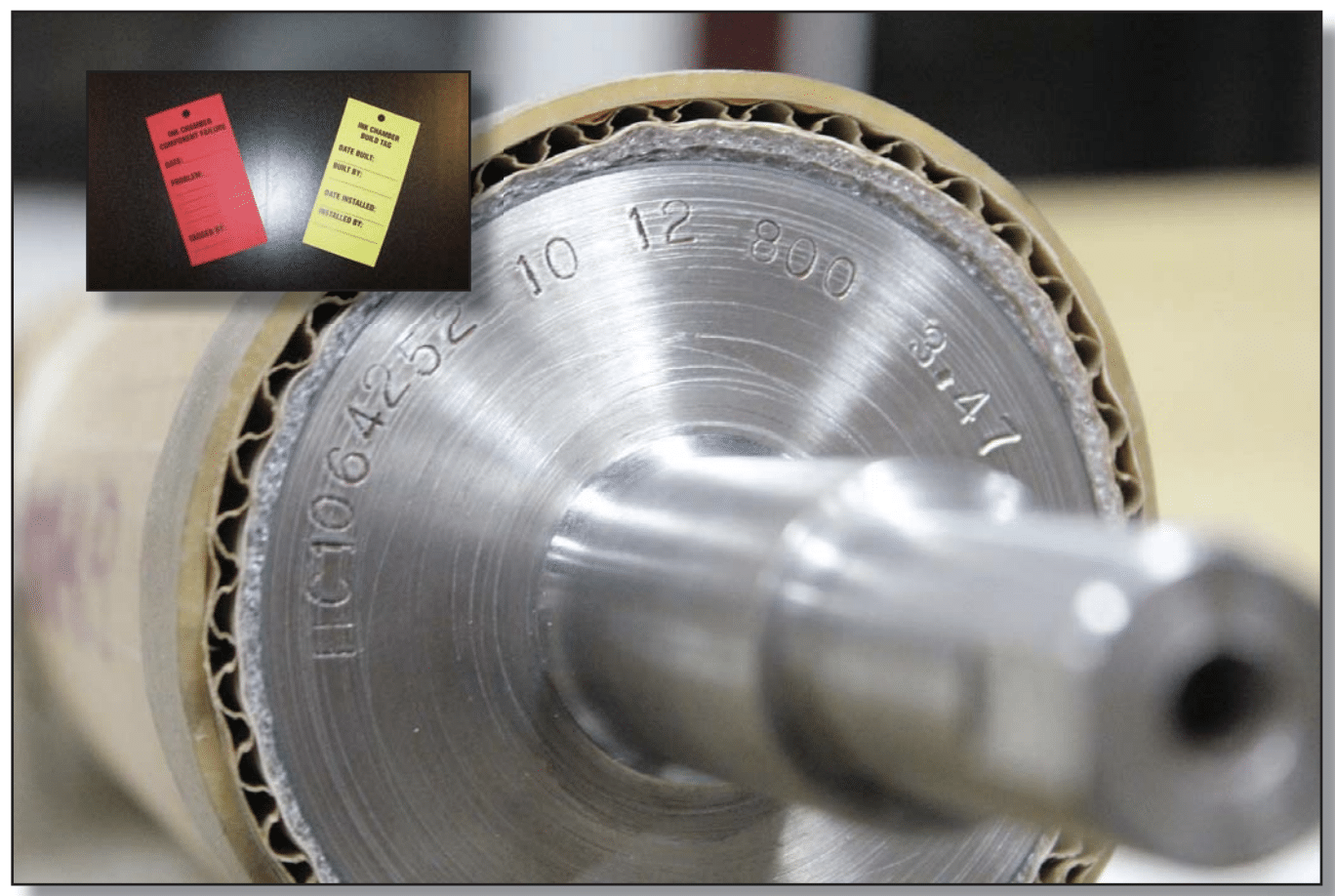
a. Have an active inventory list put together for each press line or press type. This will allow you to track each roller as it comes into your plant. Once the roller is unpacked it should be identified and listed into inventory. Place a new number on each roller for easy identification and make sure that number correlates with the manufacturing number supplied as well. Document date-in, as well line screen, volume and any other data that is necessary

b. Create a tagging or identification program. Tags should mirror the anilox list

c. Once the tag is assigned to a specific anilox roller, it will stay with that roller. This has to be known to all that handle these rollers. The tag will be listed at the press station when the roller is placed into the press as well. If this practice is maintained, the system will take care of itself and all anilox rollers will be identified at a glance, wherever they are in the building.

d. Have your anilox supplier audit and monitor your inventory at least once a year. Handling and care are given when you are discussing anilox roller wear and the everyday issues that arise. Most converters have issues with the basics, and that is where you have to start. All the work is done upfront by the anilox coordinator, so the operators only have to make sure that when the time comes for putting a system together, they only have to manage the tags and make sure they stay with the rollers. This simple method will need a person to manage it. It is not a full-time job but needs to be done by an individual that is methodical in his or her duties.


INK FLOW & DOCTOR

Filters and magnets help assure that the ink stays clean and flows well. Ink goes to a solid state if pH drops. Solvent inks start to solidify and get more abrasive and affect friction of blade to the anilox surface. Photos: Harper GraphicSolutions.

Everyday issues can affect anilox wear. Look at every area within the flexo process that comes into contact with the anilox roller. Start with the ink system. Getting the ink to press and keeping the system clear of contaminates is a key issue. Newer presses use double pump systems to keep pressure down within doctor blade chambers. Keeping these pumps synchronized, so that they always pump at the correct intervals, affects ink flow to the anilox surface. This makes sure we keep a reasonable level of negative pressure in the ink chamber. This is most important when running at high speeds above 1,000 fpm. Make sure that the pumps are synchronized and this will directly affect ink flow within the chamber.

Ink should always have a slow and steady stirrer. Do not depend on the agitation of the pump or the impellers to do the stirring. Stirring the ink should be independent of pumping. Excessive pump pressure or over stirring the ink will introduce air into the ink.

If pumping ink to the pressroom from another room within the building, make sure that the ink lines stay clean and free of corrosion. Stainless steel lines are recommended, so that corrosion does not become an issue over time.


INK VISCOSITY

Ink viscosity goes up and the ink starts to solidify. That causes more friction at the surface of the anilox roller. Maintain the proper viscosity. Know what the viscosity is for every color in the press and document it. The pressroom environment can cause the ink to evaporate solvents at an accelerated rate. When this happens, you will notice the viscosity goes up quickly and has to be maintained more often. This is where you need to take notice and check ink at intervals that will keep the viscosity from affecting the ink’s color and flow rate. Always add ink to the press at the running viscosity.


MANUAL CHAMB

Manual chambers for older press types will have manual inking systems. Make sure that the ink viscosity is maintained and the ink has a good flow. The ink return line should be twice the diameter than the in-feed line. If the chamber empties ink too fast, you will get starvation; not fast enough, you will create positive pressure within the chamber. If you have a dated system and cannot control the ink rate as well as needed, it can be adjusted with a hose clamp. Using more pump speed, as long as you do not whip or agitate the ink, can help as well. Do not put too much positive pressure into the ink chamber, or you will get end seal leakage and poor doctoring


INK FILTRATION MAGNETS

Ink filtration is mandatory. Have proper magnets needed for the ink type being used. Ink gets contaminated over time, so filters and magnets will help assure that the ink stays clean and flows well. Maintaining the proper pH and viscosity for the inks will also keep the ink flowing properly as well. Ink goes to a solid state if pH drops or when we get low in solvent blends the solvent inks start to solidify and get more abrasive. When this happens, the ink directly affects friction of blade to the anilox surface. Plugged anilox cells cause more friction at the surface of the anilox. Cleaner rolls wear less.


SCORE LINES

Many factors come into play that can create scoring. Score lines can come from ink contamination and ink abrasion, excessive blade pressure, blade alignment and many other indirect contact points to the anilox roller. Doctor blade pressures and doctor blade alignment is one of the most important factors to control day-to-day along with good end sealing of the chambers. When end seals leak the common response is to apply more blade pressure to seal the chamber and slow down the leak.

Corrosion can occur over time with a chamber, especially if using water-based or high pH inks. Make sure chamber materials are compatible with the ink chemistry. This corrosion will also get into the ink train and cause scoring and ink contamination.

Suggested Improvements: Follow OEM recommendations – Apply rare earth magnets – Use proper filters – Check for proper blade pressure settings – Chamber alignment – Look for warping and clamp distortion – Review blade type being used – Check for excessive back doctoring and correct the problem. Apply proper filters and magnets to ensure that all debris gets trapped and does not contaminate the ink environment. Clean filters out regularly or they will cause starvation within the ink lines, throwing all adjustments you made to the ink train out of balance.


BLADE MATERIALS

Chambers that are staged and ready to go will maximize makeready times and minimize anilox wear and tear. Chamber clamps should be cleaned often to ensure there is no interference for the blade to seat in the clamp comfortably and remain void of any ripple after the clamp is tightened.

There are many blade materials and types of finishes on doctor blades, from plastic to white carbon steel, that can be used for metering. The blade on the doctoring side of the chamber usually is steel. The containment side can be either steel or plastic. Getting the chamber to seal properly is a combination of pressure setting, as well as end sealing and containment blade techniques. Those who have had ink leakage issues and have made changes to their blade and end seal settings have been the most successful with the wear and surface condition of their anilox rollers. If the chamber is not sealing properly, it needs to be fixed. This can only happen by making modifications to the end seals or repairing the chamber in some way.

Contact your blade supplier when you have doctor blade questions. There is good support in this area of the industry for help troubleshooting pressroom issues.


CHAMBER INSPECTION

Chamber inspection should start with checking chamber alignment. Everything fatigues over time. Many of the materials that the anilox chamber is made of can fatigue, warp, and go out of alignment. It is imperative that you start by knowing if the chamber is aligned properly to the anilox roller. Check for blade alignment across, as well as contact the anilox roller on each side and top and bottom. The containment side blade should make contact slightly before the metering side blade does. Include inspecting and checking for chamber alignment in the regular preventative maintenance program for the press.

Inspect the blade every time you change one. Inspect the blade that you are throwing out. This tells you a lot on how the chamber is running. Uneven blade wear, in general, is a sign that something is wrong, or out of alignment.

If at some point scoring or back doctoring becomes an issue, then changes may need to be made to the way the blades are set up in the chamber. Always start out with the OEM recommended settings first, then make changes as you go, if needed.

The blade makes contact with the anilox 100 percent of the time. It only makes sense that the alignment and pressures with that blade will make all the difference in the life of the anilox roller. It is critical that the proper blade tip, thickness, and pressures are used when doctoring the ink. Preventative maintenance needs to be done on chambers on a regularly scheduled basis. The older the chambers are, the more you need to be concerned about warping and metallurgical issues with those chambers. Take time to schedule maintenance to check these chambers out for alignment and stability on a regular basis.


CHAMBER PREPARATION

Chamber preparation is critical within the daily routine for anyone using doctor blade chambers. Keeping the clamps clean and all pressure points clear of debris will allow for a straight and even doctor blade setting. Contamination or ink debris between the clamps will cause blades to ripple. Screws and bolts that hold down the clamps need to be proper size, so that they do not interfere with the anilox surface. Newer chambers have self-clamping systems that avoid using any small screws or bolts.

The blade should never overhang the end seal, but should stop in the middle of the end seal as shown above.


END SEAL ALIGNMENT

This is an area that everyone has struggled with at some time. Proper end sealing is critical to blade pressure settings and relates directly to the life of the anilox. If seals are leaking, the first response from an operator is usually to increase blade pressure. If the blades are set properly for doctoring, you may want to look at the end seal design to make sure that a modification is needed or not in that area.

Soft to hard foam, polyurethane, felt, rubber–these are just a few of the materials that end seals are constituted from. If the seal needs more pressure from the chamber to seal properly, add 1/8-in. or so to the seal height, so that it makes contact with anilox sooner and creates a better seal.

The blade needs to rest on the end seal and stop where the land flat ends. That is where the curvature of the end seal starts for the circumference of the roller. If the blade overhangs the land flat in that area, you may have issues with ink drying under the blade and causing build up of ink there, until it finally will blow out an end seal.

Try various types of materials that the end seals are made of. Different inks require different types of materials to create a proper seal. Polyurethane rubber, felts, and soft foams all react differently, based on chamber type and ink chemistry. Based on the wear and age of the chamber, this can change over time, and by making a material adjustment, you just may get a better seal.

Water-base and solvent inks have different abrasive properties and this affects the end seals and how they seal. Also consider the compression of the seal material, harder, softer. Some presses use a dead band area in the seal location and some do not. Having an engraved seal area does keep the end seal lubricated, however, if the engraving is a low line screen, it could add more friction to the seal surface and wear prematurely. Keep this in mind when running coatings and heavier volume ink applications. The same can go for dead band identification when running sleeves. If the anilox is a 180ls cell, the anilox supplier will engrave the dead band identification with the same line screen. The 180ls is a coarse engraving and may wear the end seal prematurely.

The circumference of the end seal should match up perfectly with the circumference of the anilox roller. This is an area you do not want to force the fit. The blade should never overhang the end seal but should stop in the middle of the end seal. Whatever type of material is used for the end seal it needs to fit well all on its own. Once the fit of the end seal is verified, if there are still sealing issues, move to trying different end seal materials.

Suggested Improvements: Try different seal materials and compression – Check for proper fit end seal land, height as well as circumference – Is the end seal material compatible with the ink chemistry? – Customize the seal from what it is, to what you perceive is needed to correct the leakage.


WASH-UP CYCLE

For presses with auto wash systems, there are many critical settings that affect the ink or solvent flow during a wash-up cycle. These settings need to be verified at startup on these presses, but should also be checked occasionally to insure that they have not changed from the start date.

These settings control the unloading of ink and solvent from the chamber during the wash cycle. If not synchronized properly, they can allow the anilox to starve or not get enough solvent during a wash cycle. This allows the blades to run dry against the anilox roller. Always verify that the wash-up system is timed correctly.


BACK DOCTOR

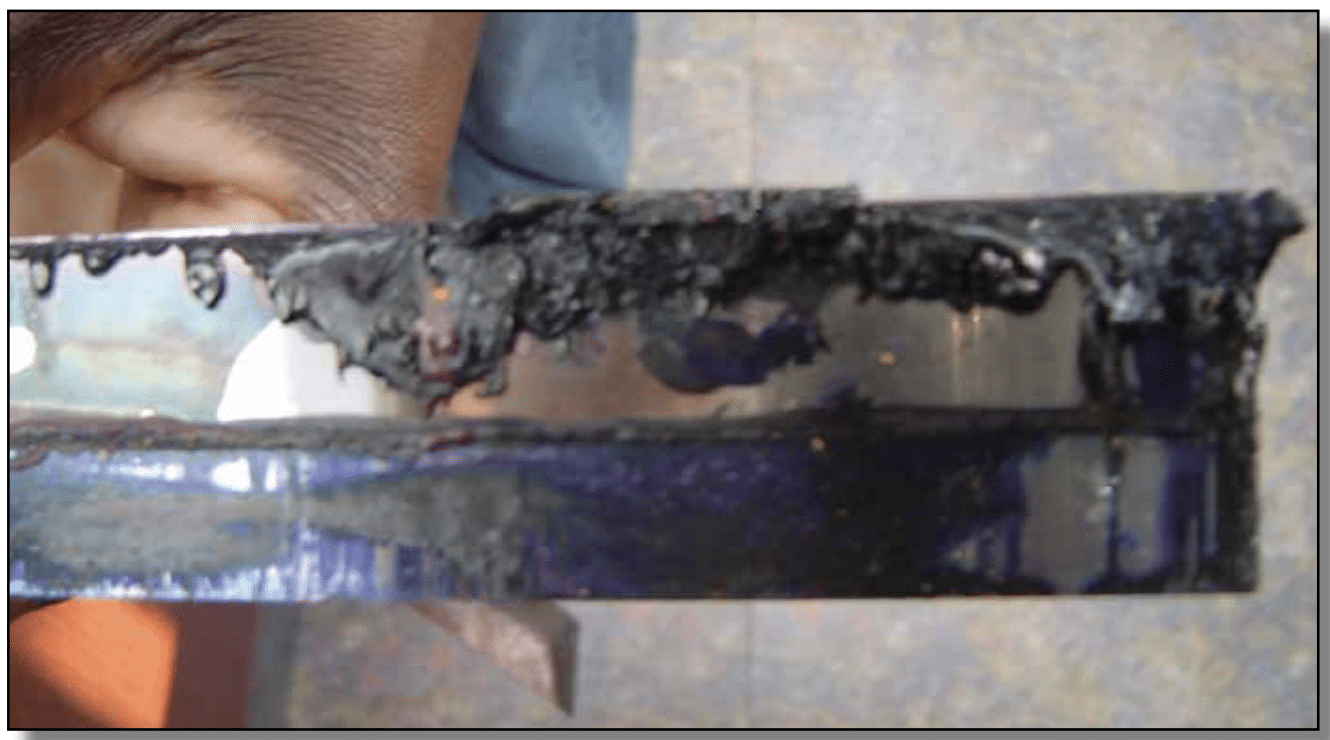
Back doctoring is noticed when you get ink in the form of stalactites dripping off the bottom clamp of the chamber. Stalactites can cause light polish lines to appear on the anilox roller. The picture shows some ink build up, excessive enough to make contact with the anilox surface. This has to be eliminated.

Choosing the correct blade thickness and edge type is important when it comes to blade wear and chamber containment. Back doctoring is an issue where ink gets doctored on the containment side, rather than going back into the chamber. Many containment blades have lower contact angles, or can be increased in length slightly to ensure that the blade does not doctor sharply against the bottom side of the anilox, but acts as a flap to let ink go back into the chamber and seal the ink as well.


Back doctoring is noticed when you get ink in the form of stalactites dripping off the bottom clamp of the chamber. As they build upon the blade, these stalactites can cause light polish lines to appear on the anilox roller. These are not score lines but they are lightly polished lines that will create a light print in that area as they polish the roller surface.


NO SHORTCUTS!

We are all guilty of taking short cuts, forgetting to follow standard operating procedures and not keeping to the specifications that we ourselves set at times. Spell out to the letter what is expected in the pressroom. Hold yourself and your people to these standards and the efficiencies expected will show benefit. If modifications need to be made, make them!

There are hundreds of variables that will affect the lifecycle of the anilox roller. When you lay all these variables out, it is easy to see why we all wrestle with the premature wear and the replacement of anilox rollers in the flexo process. From handling and care around the pressroom to constant contact of doctor blades and the heat created by the friction of those blades. Following procedures and setting standards into place is the only way to optimize profitability of the production process. The cleaner the environment is kept, the easier it is to manage and detect when any of these variables go out control.


About the Author: Bill Poulson has been with Harper Corporation of America for 14 years. He is the Northeast technical graphics advisor for the Harper Graphic Solutions Division. He works directly with all narrow and wide web coaters and printers in flexo and gravure.


To view the original FLEXO Magazine article click HERE.
Here, Harper’s Bill Poulson gives some recommendations on how care and maintenance should always be top priority

First published in Tissue World Magazine, December 2012 issue.

Written by Harper Technical Solutions Manager, Bill Poulson


The more that is learned in the area of care and maintenance of Anilox rollers, the less downtime and product loss will occur. Anilox rollers in the tissue industry are used in glue application and lamination processes as well as printing rollers for single color or four-color process toweling print lines. Other markets such as party goods and dinner napkins are also printed on tissue. What is unique about this industry is that once the Anilox is installed in press it will spend its entire lifecycle there as the tissue industry uses the same line screens and volumes. This is very different compared to other segments of the flexo industry that may have to change rollers from job to job.

Because the tissue industry’s rollers stay in the press, are very large, and the inks and glues usually do not get cleaned out of them thoroughly, they will lose their volume capability for ink or glue transfer due to this plugging process. Cell plugging can be avoided by implementing good manufacturing practices. Once you have identified the problem you are half way to fixing it; if the problem is not identified, this can shut down the print or glue lamination lines.


Care and maintenance

Tracking wear and tear is a very important step as illustrated on the next page. This allows a tissue producer to determine an expense budget as well as giving a snap shot of how the rollers are being handled and cared for weekly. Roller suppliers should come in periodically to perform audits and between that tissue producers should use a qualified handheld microscope to visually check for cell wall wear and ink plugging on a weekly basis.


Cleaning the anilox rolls; “Clean cells”

Daily procedures for cleaning are needed. Whether anilox rollers are used for printing ink or running adhesives, they need to be cleaned quickly and thoroughly. Again, this is where the handheld scope comes into play. Personnel should be trained on the visual inspection of an Anilox or glue roller, and don’t just depend on the auto wash systems to get this done. Remove all residual ink and this will avoid the ceramic surface from getting stained and minimise any plugging or corrosion issues. With the proper magnification it’s possible to tell if the roll is plugged, and if the bottom of the cell is visible it’s clean. If the roll is plugged with ink it will not perform as expected. Auto wash systems should be done with warm water treated with a compatible detergent that will help flush out the cells properly during the wash cycle. Use a detergent that has a safe pH level and also check the roller after the wash cycle to insure it is cleaned thoroughly.


Offline and online cleaning systems

Most T&T facilities can have an outside source come in and clean their rolls on press. One common practice is the baking soda blast which can be attached to the press onsite without taking the roll out of the press. If the rolls plug over time and you cannot get them cleaned by hand, an online and onsite service should be scheduled for once or twice a year. It will pay itself off in product consistency and less quality control issues.


Barrier Coating

Inks and adhesives in the tissue industry can be acidic or caustic causing the ceramic surface of the roller to decay. These inks are formulated to avoid ink bleed, streaking and other such issues that can complicate ink related handling. To avoid this, make sure that the proper barrier coating is applied to the subsurface of the roller, which is the build-up material under the ceramic.


Production environment (dusty)

The tissue environment will be dusty. The print surface of the Anilox roller should be protected or covered to limit the amount of dust that will contaminate its surface when not in use. Once the dust gets into the system it will travel through the ink train or adhesive train spreading the contamination throughout. This can promote rollers to plug cells or have issues printing acceptable product. Dust will cause print quality issues and will flow through the chamber contaminating the ink. Proper filtering needs to be in place to trap the contamination while running. If anilox roller has not been in use, clean it thoroughly before pumping ink or glue to the rollers surface.


Choosing the proper ink or glue volume

Standard Anilox volume for T&T lines is 3.5bcm to 5bcm range. This volume range may vary slightly depending on inks, paper or other variables. If you include party napkin in this mix, the volume range will go slightly higher than 5bcm. Glue applications: In testing for glue applications, the volume ranges will vary from what is used for printing as pictured. Most manufacturers of T&T will run periodic testing from time to time. Tissue is a very absorbent substrate so if the tissue supplier changes the tissue formula, there may be a need to retest in order to optimise ink or glue volume. When these types of changes occur, banded testing is the way to get the process optimised again. Glue coat weight amounts are slightly more difficult to calculate than ink. This is a perfect example for running a banded roller. A banded roller is a roller that has multiple bands of line screens and volume as well as different geometries to test so that you get the optimal amount of ink or glue transfer.


“Banded roller layout”

A tissue producer may want to try a variety of geometries. Flexography typically uses 60 degree geometry which will work fine, but there are other geometric types that may work in replacement of the 60 degree. Consider speed and chemistry of inks and coatings when choosing geometry. The trihelical or 89 degree geometry on previous page works well with glue but it may allow a coating to sling at speeds above 200meters, so make sure this can accommodate any issues or side effects that certain geometries may show.

After running the banded roller, evaluate the test results and measure the final results to set the parameters needed for day to day operation. If a coating volume for glue needs to span across a variety of tissue weights, then this is the proper way to get there with accuracy. Interpret the final results and choose a volume range that will span across the full range of tissue ply and paper weights that are produced. The final volume selected needs to be at a high enough volume to allow for slight wear and still have acceptable coat weight for glue or color strength.


About the Author: Bill Poulson has been with Harper Corporation of America for 14 years. He is the Northeast technical graphics advisor for the Harper Graphic Solutions Division. He works directly with all narrow and wide web coaters and printers in flexo and gravure.


To view the original Tissue World Magazine article click HERE.
FIRST: Printing’s Five S’s—Sort, Set in Order, Shine, Standardize & Sustain

First published in FLEXO Magazine, November 2012 issue.

Written by Sean Teufler and Johnny Dye


Utilize tools like pads, brushes and sponges for plate cleaning, both for the image surface to avoid print defects and the back of the plate to remove residue interfering with adhesion to the mounting tape.

One of the most pressing problems that hinders the flexographic process is tinkering—a blend of undefined print processes and uncontrolled press inputs, held together by a print culture that sustains it. Issues that develop from this concoction often force a press operator to compensate for shortcomings in hopes of achieving an acceptable quality outcome; but alas, the fruits of this labor can be rejected product, unsatisfied customers and lost opportunities.

If tinkering is so obvious, then why does it happen? Two reasons:

1. Necessity, because the operator doesn’t have a choice but to try to make it right

2. Print culture, which develops over time

So, what can be done? First, we must get the print process under control. We must define the press inputs and decide on simple checks and balances, while understanding the limitations of the operator with each input. Lastly, we must address how to change the print culture.

In order to have a good grasp on consistency, a process must be defined and standards must be upheld. While there are various opinions in the industry on how to achieve desired outcome, all can agree that Flexographic Image Reproduction Specifications and Tolerances (FIRST) guidelines provide the basic understanding for control and repeatability in the flexographic process.

Think of FIRST as the “Five S’s of Printing.” You sort, set in order, shine, standardize and sustain. This journey begins at press by doing an optimization of your press operation, thereby assuring yourself there are no mechanical issues that will hinder the print process. Gears, bearings, frame walls and drying function are some of the many sources of mechanical problems. Press cleanliness is also very important to maintain.

We often find tinkering related to fatigued equipment. Equipment must work as designed, or it will cause problems for you when it counts. Smart tool selection is part of it. When we talk about the right tools, we often think of the basics. Also, consider tools for the operator that help maintain the process, like tools for measurement and inspection. Once a press can hold proper register, avoid adding to physical print changes, like bounce or chatter, and adequately dry the ink, you are well on your way to having an optimized print process.

We often find optimization steps skipped, only to rear up during the print process. Once an optimization has been completed, you define the print process and capabilities by doing a fingerprint. Fingerprinting is the step where numerical values are defined and which will allow for measurements and repeatability. All conditions need to be documented, like tension, tools used—tape, plate, ink type, anilox, etc. Many of the inputs we will discuss later on.

Once the press capability is harnessed, a characterization run will allow the prepress team and customer to realize the full potential and limitations of a particular press and the combination of variables, based off of repeatability. Lastly, and most importantly, these three steps of Optimization, Fingerprint and Characterization, will undoubtedly improve communication among all parties and build a foundation of understanding for further process improvement. Please remember, maintain the press if you expect to sustain repeatability.

Press inputs are defined as the parts that come to the press, so a print job can be assembled and printed. Again, the five inputs are prepress, ink, anilox, plate/mount and print samples. Furthering the investigation of these sources, two classifications were developed:

1. Internal—what the operator can do at press

2. External—what must be done before going press


PREPRESS FUNCTIONS

Let’s look at prepress from the viewpoint of the operator. What are the realities? Internally, the operator can only maintain proper press conditions. Thinking about it, any changes in printing process to satisfy one area would yield undesired consequences to other areas. A normal, repeatable setup, which the operator can supply will serve to isolate a prepress issue, but not address it. In these cases, the problem must always go back upstream.

Externally, there are a few common sources you will want to examine to see if they are addressed in the operation. Certainly, an operation would want to be based on a fingerprint/ characterization where standards have been established for both press and prepress. Print efforts that avoid this basic tenet of process control and capability will be fraught with problems.

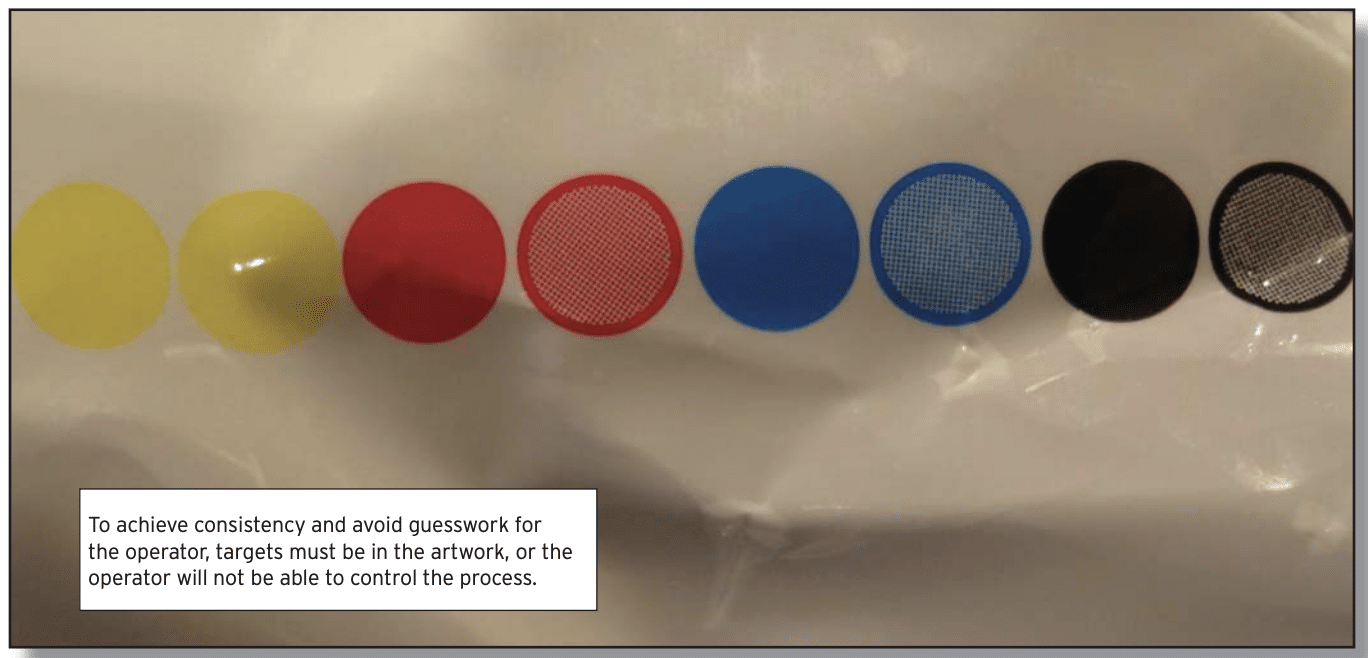
To achieve consistency and avoid guesswork for the operator, targets must be in the artwork, or the operator will not be able to control the process. If an operator is asked to qualify and run a job without control targets to help them measure, then you can guarantee different results from what is desired and no consistency from run-to-run.

Control must be accounted for, or expectations will be dramatically lowered. Artwork that is inherited from the customer and processed without re-separation to your press parameters will create unpredictable outcomes, so ask your customer about doing a reseparation and including pertinent targets.

Certify the rolls and chambered doctor blades through a tagging system that makes identification simple. Also, flag potential issues associated with using an anilox with a minor flaw.


INK FUNCTIONS

All inks can be compromised due to temperature extremes or contamination. The external ink process must deal with three main issues; ink selection, color match and then storage. Specific selections should be determined in a lab through testing

Ink serves to provide three things: color, printability and adhesion to substrate. What are the expectations for an operator when it comes to ink? Internally, operators have one objective; maintain condition. When it comes to ink condition, there are four that must be met at press.

• If running water base, think of maintaining pH and viscosity

• For solvents, maintain viscosity with the proper blend

• For UV, avoid any light sources

All inks can be compromised due to temperature extremes or contamination. The external ink process must deal with three main issues; ink selection, color match and then storage.

• Ink selection should always focus on formulation, chemistry and adhesion to substrate. Specific selections should be determined in a lab through testing and should stay within the realm of ink suppliers and support staff

• When it comes to color matching, uncontrolled batches are probably the single greatest generator of waste in time and material at press. Much can be done beforehand to prevent all the waste. Have a vetted, stable proofing method, so the results are repeatable. If you cannot proof directly before going to press with an ink, retain wet samples of the matched ink made in press for later use in proofing new batches. Document batch formulas and any adjustments and recalculate for future use. Make sure you have a way to capture data by using spectrophotometers, viscosity checks, etc.

• Ink storage may seem like a mundane exercise, but inks saved for another run play a critical role in tinkering. Inks are challenged by their environments. Controlling the elements of aging, exposure to air, light and temperature extremes are as vital to storage as they are in press.


ANILOX FUNCTIONS

Aniloxs, hand-in-hand with doctor blades, supply a measured amount of ink and support the graphic image. Aniloxs are no exception as a source of tinkering. What would be our expectations of the operator? Internally, an operator would be expected to handle the primary cleaning process, maintain the physical condition, have aniloxs that are stored at press ready to go and be expected to use a simple scope to verify that cleaning methods are effective.

The key to anilox cleaning is to maintain wet ink on the anilox. Have the operators document the ink station shutdown procedure, keep it in mind and focus first on getting the anilox clean. Aside from the documentation, make sure you use a cleaner that actually works on the ink system you are cleaning up. Make sure the cleaners are anilox safe and those using them have the proper personal protection. If you decide to change cleaners, you may need to rework the cleaning documentation to reflect the new method.

External to the press, you would consider a secondary cleaning system like, media or soda blast, ultrasonic, soak tank, dishwasher type or laser. While there are a variety of systems to choose from, the most important point about any of them is keeping them maintained to the OEM specifications.

Equipment works best when operated under proper conditions of air pressure, exposure time, temperature, rotation and media type/specification. When the systems are not maintained, the cells won’t get cleaned and under extreme settings/conditions they can also become damaged.

Anilox maintenance has both internal and external functions. Internally, an operator would be expected to be responsible for the physical location of the anilox, including roll protection. Bearings and gears need to be maintained and checked for any signs of failure; before aniloxs suffer as a result. Externally, maintain a supply of gears and bearings that meet specifications. Anilox selection becomes a simple process for the operator in a standardized setting. Aniloxs should be defined from a job setup and from external selection processes.

Using a planned experiment featuring a banded roll or using a qualified recommendation, standardization of anilox specifications can reduce the variation found in uncontrolled inventories and narrow down to just a process, line/combo and then what is needed for specialty applications like metallic, opaque white, fluorescents, adhesives. Based on all this background work, operators should then be able to answer three simple questions when looking at an anilox:

1. What is it?

2. Where does it go?

3. Is it ready to be used?

Anilox verification is something that an operator can quickly do with a simple scope system. Once an anilox is cleaned at press, perform a quick examination for damage and cell cleanliness. This simple step avoids lengthy delays in press. Externally, once a roll has made it out of a secondary cleaning system, more sophisticated inspection systems can be used to recertify rolls. These systems need to be calibrated to be an effective measurement of anilox condition. Alternatively, aniloxs can be audited periodically by the anilox suppler.

The benefits of an audit include a fresh set of eyes to detect problems early, which often saves the bulk of the inventory from damage by raising awareness. After the cleaning and verification, certify the rolls through a tagging system that makes identification simple. Also, flag potential issues associated with using an anilox with a minor flaw.


PLATE MOUNTING FUNCTIONS

As plates and mounting relate to the operator, there are three items he or she can attend to. He/she must be able to clean the plate properly without causing plate lift, install without damaging and maintain the physical condition.

Externally, there are many pitfalls that must be avoided and can be addressed with a thorough inspection process. It begins by having the entire plate inspected for cracks, wrinkles, lost images or underdeveloped images. Lost images would include targets that have been removed for whatever reason. Remember that without measurable targets, the operator cannot measure and control and will be forced to make blind adjustments and tinker.

Utilize tools like pads, brushes and sponges for plate cleaning, both for the image surface to avoid print defects and the back of the plate to remove residue interfering with adhesion to the mounting tape. Tape selection should already be defined by the fingerprint. Mounting hardware should have an undamaged surface as those defects will otherwise translate to the print. Cylinder and mandrel accuracy must also be checked. Follow OEM protocols when designing best practices for these components.

Any platemounting equipment must be up to par. Components like bearings, locking head position, camera position must be evaluated and mechanical play must be eliminated.


PRINT SAMPLES

When an operator is provided a printed sample to match, he/she is faced with a very difficult situation. Operators can only match within the realm of specification determined by process and press capability and print samples may fall well outside those parameters.

Internally, all one can ask an operator to do is maintain the sample, look at it under the appropriate light source and measure when possible to verify a match. Often, the samples will run afoul of press capability because the sample was not originally run to some standardized format.

Operators can only match within the realm of specification determined by process and press capability. Print samples may fall well outside those parameters.

Externally, determining the true specification and communicating amongst all parties is essential to provide an operator with the needed target. Age of the sample and substrate condition affect the color perception and must be taken into account. Illumination is a standard that must be established between customer and printer. Illumination often reveals differences in pigments from what was used in the provided sample to the pigments used in your ink system.

Samples must be usable, meaning they are not in a destroyed condition. The customer needs to let you know if the provided sample reflects the true quality expectation or is it for fit/form/function only. Quantify the sample by using measurement. It is considered a best practice to write out and execute a process of communication for customer/sales/ prepress/printer to get the right information. Book standards may differ, so consider assigning a custom color to a match if it does not truly match any known color.

The last element to eliminate tinkering at press is to create a cultural change. There are five elements: management structure, support, process improvement technique, training and equipment analysis

Management must buy-in to the cultural change. If an operator reports that something needs to be repaired or done differently, management needs to listen and act. The essential elements of management can be split between supervisors and managers.

• Supervisors should have control of communicating to those supplying all the press inputs. They should also be interested in developing the skill set of the operators and insist proper press conditions are maintained

• Managers must communicate the results of these efforts, ensure support personnel have the necessary skills. Managers must also recognize and encourage the vital importance of press maintenance, which includes periodic shutdowns

Process improvement is the mechanism for making things better. Original processes must be documented and any changes must be carefully monitored for determining the added value. Through these efforts, greater attention to detail is created and that alone is a justifiable reason for process improvement.

Skill development is much more rapid and to the point if developed through training. For anyone to improve he/she must first understand; to understand, he/she must learn; to learn, he/she must seek knowledge. Get that knowledge from the FTA, schools, trade publications and suppliers. Training is reinforced through mentoring and skill demonstration. Incorporate both in your training program.

Also consider cross-training between departments to develop a much greater understanding of the entire process. Operators must adapt to their press culture the element of equipment analysis. How often do you find someone working with broken or substandard equipment that under the best of circumstances will not perform adequately? Worn and broken parts must be identified and eliminated.

Whenever pre-operations don’t go as planned…. you will get experiments and manipulations at press. This dynamic is known as tinkering. Build yourself a solid foundation following the FIRST principles and then look at your processes. Knowing that print expectations can never really be achieved by constantly modifying from the script, we must address the upstream problems before they get to press. Give each member of the upstream process the responsibility to manage and monitor his or her area of expertise. Create a cultural change that discourages tinkering instead of enabling.

Operators of presses must understand the limitations they face, how to recognize them and what their true roles are at press. These roles are limited to repeatable setups, following the recipe and sustaining the print capability. Anything else falls under the category of tinkering. Remove the obstacles to your printing process by getting rid of wasteful practices and become more competitive today.


About the Authors:Sean Teufler, technical graphics advisor, Harper GraphicSolutions, has been a part of Harper Corporation of America for more than nine years. In that time he has been “Tech of the Year” for Harper seven years in a row. Sean stays active in the industry committees, among them Flexographic Technical Association’s Supplier Leadership Council and Flexo Quality Consortium (FQC). Teufler, a familiar speaker at many FTA and other industry events, was recognized earlier this year with the 2012 FTA President’s Award for Leadership Excellence. He is a Level 3 FFTA/TEST Certified Implementation Specialist.

Johnny Dye is printing operations manager, Accredo Packaging, Sugar Land, TX. He and Teufler served as co-chairs of last month’s FTA Fall Conference—Efficiency in Flexography: Connecting the Dots, where they collaborated in jointly presenting a pre-conference workshop entitled, “Taking Tinkering to Task.” This article both summarizes and supplements their remarks and observations that were delivered in Milwaukee.

He started his journey in the flexographic industry in 1991. During his 21-year career, Dye has worked for two of the largest and most respected converters in North America; serving multiple locations all over the country in the fields of press and prepress management. Johnny has been working for Accredo Packaging, Inc. for the last four years. He stays very active in the FTA, and served as a speaker at the 2012 Forum.


To view the original FLEXO Magazine article click HERE.